The personal development industry keeps growing steadily, with North America maintaining a dominant position and strong demand for coaching and training programs focused on building essential skills. Companies are turning more attention toward emotional intelligence as a practical way to improve leadership effectiveness, strengthen team collaboration, and create healthier workplace dynamics.
Across corporate boardrooms and team meeting spaces in North America today, a noticeable change continues to take hold. Seasoned executives and rising managers alike are discovering that pure logic and positional authority often fall short when emotions run high. The traditional toolkit presenting more data, issuing directives, or simply sidestepping tension frequently intensifies conflict instead of defusing it. In contrast, leaders who learn to read and respond to emotional undercurrents are finding they achieve faster alignment, fewer lingering resentments, and stronger overall performance.
Doug Noll, an award-winning mediator with more than four decades of hands-on experience, has dedicated his career to turning volatile situations into moments of clarity and calm. As the creator of the Noll Method™, he developed a neuroscience-informed de-escalation technique frequently called the “90-Second Power Move” that uses carefully chosen emotional language to lower arousal levels rapidly. The approach has proven effective in some of the most challenging environments imaginable, from maximum-security prison yards to high-stakes executive suites, demonstrating that skillful empathy is not a soft skill but a concrete, results-oriented communication strategy.
Emotional conflicts fracture teams and families. The ongoing tension breeds burnout, damages relationships, and hurts performance. The Noll Method’s 90-Second Power Move™ is a proven, neuroscience-based skill for restoring calm, tested from boardrooms to maximum-security prisons. Master this life-changing technique to transform chaos into collaboration. Book a no-obligation zoom call with Doug Noll today!
The Real Price of Dismissing Emotions in the Workplace
Far too many organizations still operate under the unspoken rule that emotions should be checked at the door. Managers press ahead with agendas and metrics, expecting rational discussion to carry the day. Yet when a colleague feels ignored, disrespected, or unfairly treated, the brain registers a threat. Stress hormones rise, focus narrows, and what began as a minor disagreement can quietly erode trust and cooperation for weeks or months.
Modern neuroscience provides a clear explanation and a workable solution. A well-researched technique called affect labeling simply naming the emotion someone is experiencing quickly down-regulates the amygdala while activating regions of the prefrontal cortex associated with reasoning and self-control. Groundbreaking work by Matthew Lieberman and others has shown that putting feelings into words produces measurable calming effects in a matter of seconds rather than hours.
In everyday leadership situations this translates into powerful, low-risk interventions. Instead of immediately offering advice or defending a decision, a manager might say, “You sound genuinely frustrated right now,” or “This feels really disappointing to you.” Delivered cleanly and without judgment, that single sentence often reduces defensiveness enough for constructive conversation to resume.
Why Affect Labeling Outperforms Conventional Listening Techniques
Many professionals are already familiar with active listening paraphrasing what someone has said to show understanding. Affect labeling takes a different path. Rather than reflecting content or intent, it targets the raw emotion itself and names it directly, setting aside the narrative details at first. That narrow focus makes the intervention surprisingly potent, especially when time is short and stakes are high.
Picture a strategy session where one executive sharply questions a proposed direction. The instinctive response might be to justify the plan or redirect the discussion. A leader trained in the Noll Method, however, might pause and respond: “You’re sounding pretty angry and maybe overlooked.” When the naming is accurate and unadorned, resistance usually drops. The speaker feels seen, the emotional charge decreases, and the group can return to the substance of the issue with clearer heads.
Noll has taught this precise skill to Congressional staffers, senior corporate leaders, law enforcement professionals, and others who routinely operate in emotionally charged settings. Participants consistently report quicker de-escalations, deeper trust within teams, and fewer meetings that spiral out of control.
Turning Empathy into a Core Leadership Strength
Real empathy in a business context is far more than politeness or sympathy; it is an operational advantage. Leaders who consistently create psychological safety encourage candid input, higher creativity, lower voluntary turnover, and better collective decision-making under pressure.
The catch is that good intentions alone are rarely enough. Generic statements such as “I can see you’re upset” can land as superficial or even patronizing. Precision matters. The Noll Method drills leaders in accurate, moment-to-moment emotional naming so the practice feels authentic rather than rehearsed.
What sets Noll’s teaching apart is the depth of his background. He spent years training individuals serving life sentences to interrupt cycles of prison violence using these same tools. If the method reliably reduces aggression in one of society’s most volatile environments, its relevance to corporate disagreements where the currency is reputation, morale, and revenue rather than physical safety becomes even more compelling.
Answering the Most Common Skepticism
Leaders frequently voice the same reservations when first introduced to empathy-driven de-escalation. “Won’t pausing to name emotions slow everything down?” In most cases the opposite happens: a well-timed 90-second intervention prevents a 30-minute argument or days of simmering tension.
“Aren’t we supposed to keep things professional and leave feelings out of it?” The reality is that unaddressed emotions already disrupt professionalism far more than briefly acknowledging them ever could. Ignoring the human element rarely makes conflict disappear; it simply drives it underground where it does greater damage.
Another frequent concern: “Conflict is just part of business life.” True differences of opinion are inevitable. The critical variable is how those differences are handled. Empathy-based techniques do not pretend to eliminate disagreement; they stop routine friction from escalating into destructive standoffs and help turn it into productive debate instead.
Finally, some hesitate because engaging emotions feels risky or vulnerable. Paradoxically, the leaders who master staying calm while others are activated gain more influence and credibility, not less.
Concrete First Steps Any Leader Can Take Today
You do not need advanced certification to begin. In your next tense interaction, try this sequence:
- Shift attention to the emotion present before focusing on the spoken words.
- Name it plainly and specifically: “You’re feeling really overwhelmed,” or “This situation seems unfair to you.”
- Resist the urge to solve, explain, or counter right away.
- Remain fully present and listen to whatever emerges next.
Repeated practice turns the pattern into second nature. Teams soon notice the change: discussions stay on track, feedback flows more freely, and collective energy improves noticeably.
Structured Learning and Supporting Materials
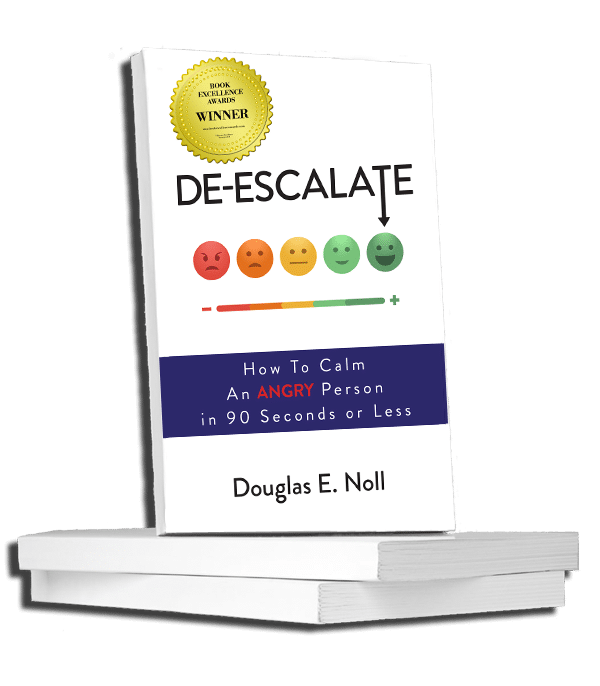
For those ready to go deeper, intentional training accelerates progress. Noll delivers live workshops, one-on-one coaching, and scalable online programs. His bestselling book De-Escalate: How to Calm an Angry Person in 90 Seconds or Less offers step-by-step guidance and dozens of real-world illustrations. Organizations that embed these skills through customized curricula report measurable gains in meeting effectiveness, employee engagement, and conflict-related downtime.
A Practical Evolution in Modern Leadership
The strongest leaders no longer view emotions as noise to be silenced; they treat them as valuable data to be engaged with precision. Tools like affect labeling allow them to convert charged moments into bridges rather than barriers.
This transformation rarely demands a complete cultural overhaul. It starts with a single well-placed acknowledgment, one calmer exchange, one meeting that ends on time and in alignment rather than frustration. Those small wins accumulate. Over months and years they reshape how teams communicate, solve problems, and weather inevitable stress.
In today’s high-pressure business environment, where clear thinking and rapid collaboration are non-negotiable, the capacity to de-escalate skillfully may well become a defining competitive advantage. The neuroscience is solid, the field experience is extensive, and the potential payoff in productivity, retention, and innovation is hard to overstate. The only remaining question is how quickly forward-thinking leaders will make the shift.
Frequently Asked Questions
What is affect labeling and how does it help de-escalate workplace conflict?
Affect labeling is the neuroscience-backed practice of naming the emotion someone is experiencing in the moment for example, saying “You sound genuinely frustrated right now.” Research by Matthew Lieberman and others shows this simple act down-regulates the amygdala and activates the prefrontal cortex, producing measurable calming effects within seconds. In workplace settings, this technique can quickly reduce defensiveness and create space for constructive dialogue, making it a powerful tool for leaders managing tense conversations.
How does the Noll Method improve leadership communication and team performance?
Developed by award-winning mediator Doug Noll, the Noll Method™ is a neuroscience-informed de-escalation technique that trains leaders to accurately name emotions in real time rather than defaulting to advice-giving or conflict avoidance. Leaders who practice this approach report faster alignment, fewer unresolved resentments, and stronger team trust. Organizations that embed this method through structured training see measurable improvements in meeting effectiveness, employee engagement, and conflict-related downtime.
Why should corporate leaders prioritize emotional intelligence over traditional authority-based management?
When employees feel ignored or disrespected, the brain registers a threat stress hormones rise and rational collaboration breaks down, often derailing productivity for days or weeks. Traditional management tactics like presenting more data or issuing directives can actually intensify conflict rather than resolve it. Leaders who develop emotional intelligence skills, such as empathy-driven de-escalation, gain a concrete competitive advantage: higher psychological safety, better decision-making under pressure, and lower voluntary turnover.
Disclaimer: The above helpful resources content contains personal opinions and experiences. The information provided is for general knowledge and does not constitute professional advice.
You may also be interested in: Why Conflict Resolution Training Works Despite Skepticism
Emotional conflicts fracture teams and families. The ongoing tension breeds burnout, damages relationships, and hurts performance. The Noll Method’s 90-Second Power Move™ is a proven, neuroscience-based skill for restoring calm, tested from boardrooms to maximum-security prisons. Master this life-changing technique to transform chaos into collaboration. Book a no-obligation zoom call with Doug Noll today!
Powered by flareAI.co