Quick Listen:
In recent years, a string of high-profile confrontations across the United States and Canada has once again placed de-escalation training under intense public scrutiny. Despite widespread discussion, a surprising number of people practitioners and observers alike continue to harbor fundamental misconceptions about what de-escalation actually entails and what it can achieve. Far from representing a retreat from responsibility or authority, carefully designed de-escalation approaches frequently deliver stronger safety outcomes, fewer injuries, reduced complaints, and meaningful cost savings. The evidence emerging from North American policing, healthcare, workplaces, and public-facing services tells a consistent story: when executed well, these techniques often produce better results than relying solely on traditional control methods.
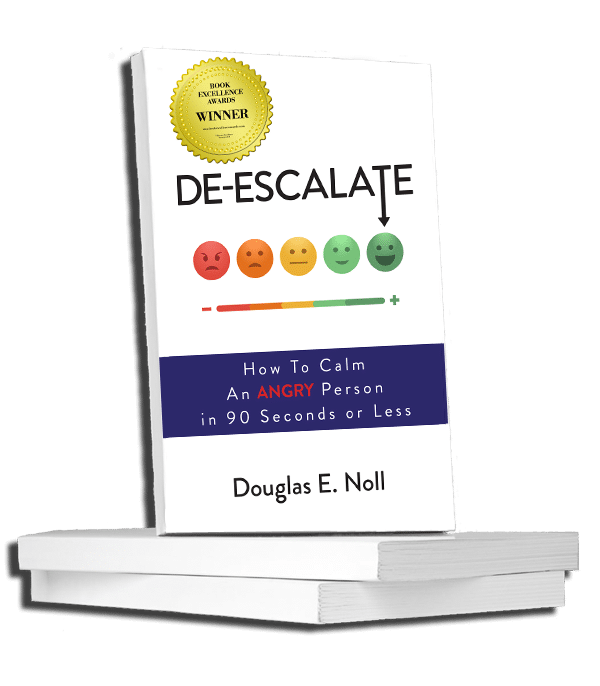
Emotional conflicts fracture teams and families. The ongoing tension breeds burnout, damages relationships, and hurts performance. The Noll Method’s 90-Second Power Move™ is a proven, neuroscience-based skill for restoring calm, tested from boardrooms to maximum-security prisons. Master this life-changing technique to transform chaos into collaboration. Book a no-obligation zoom call with Doug Noll today!
Why De-Escalation Commands Renewed Attention
North American institutions are investing substantial resources in conflict-prevention training. Visible failures to manage tense encounters have underscored the very real human and financial toll of escalation. Agencies in policing, hospital emergency departments, retail environments, customer-service operations, and even corporate security teams now treat de-escalation as a frontline competency rather than an optional add-on.
The U.S. Department of Justice and Public Safety Canada have both identified structured de-escalation as a critical element of modern safety strategies. What fuels the momentum is not idealism but hard data: programs that emphasize tactical communication and time management routinely correlate with lower rates of physical force, fewer injuries to citizens and staff, and improved perceptions of fairness and legitimacy.
Three Persistent Misconceptions
De-escalation undermines enforcement and authority
Perhaps the most stubborn myth is that choosing de-escalation signals weakness or invites chaos. Evaluations of widely adopted North American models tell a different story. Officers trained in the Integrating Communications, Assessment, and Tactics (ICAT) framework, for example, recorded 28 percent fewer use-of-force incidents, 26 percent fewer citizen injuries, and 36 percent fewer officer injuries compared with control groups. Tactical dialogue, creating psychological and physical distance, and giving people time to comply frequently secure cooperation more reliably than immediate physical intervention.
De-escalation applies only to police
Another common assumption confines these skills to law enforcement. In reality, healthcare systems across the continent have documented sharp declines in staff assaults and worker’s compensation claims after implementing violence-prevention curricula that emphasize de-escalation. Retail chains, airline ground staff, school administrators, and corporate security personnel increasingly rely on similar toolkits to manage agitated customers, upset family members, or distressed individuals without escalation to security interventions or police calls.
De-escalation is merely “common sense” anyone already possesses
Under acute stress, most people default to instinctive responses raising voices, closing distance, issuing rapid commands that research shows often accelerate rather than calm a situation. Studies conducted at Canadian universities and U.S. training academies demonstrate that structured, scenario-based instruction markedly improves performance when adrenaline is high. Deliberate techniques such as slowing speech cadence, using open-handed gestures, and employing active listening are skills that must be practiced; they rarely emerge spontaneously in high-pressure moments.
How Training and Practice Are Evolving
Contemporary North American programs increasingly favor immersive, scenario-driven exercises grounded in behavioral science over passive slide presentations. Agencies now supplement traditional completion metrics with after-action reviews of body-worn camera footage, tracking whether trained behaviors appear in real encounters and whether those behaviors correlate with safer resolutions.
Technology is accelerating refinement. Artificial-intelligence tools analyze thousands of interaction recordings to highlight patterns that predict successful versus unsuccessful outcomes. At the same time, de-escalation principles have migrated beyond public-safety agencies into education districts, private security firms, and large retail operations, where insurance providers and risk managers actively encourage adoption through premium incentives and lowered deductibles.
Evidence from the Field
Municipal police departments that prioritized communication-focused training have consistently reported meaningful year-over-year reductions in citizen complaints involving force. Community-oriented safety grants across both countries have supported similar efforts, yielding quieter streets and measurably higher public confidence scores.
In healthcare, large hospital networks that required annual de-escalation certification for frontline staff later recorded fewer Code Gray activations (violent-incident responses) and lower staff turnover in high-risk units. Peer-reviewed publications from North American medical societies reinforce the connection between consistent training and safer clinical environments.
Corporate human-resources departments increasingly cite de-escalation training as a factor in fewer contentious terminations, reduced Equal Employment Opportunity complaints, and lower exposure to customer-litigation claims. The versatility of the core principles time, distance, communication, empathy explains why they transfer so effectively across contexts.
Remaining Barriers to Wider Adoption
Implementation remains uneven. Jurisdictional differences in training standards, certification requirements, and legal frameworks create patchwork coverage. Reliable measurement continues to challenge the field; raw incident counts capture only part of the picture, while long-term attitudinal and cultural shifts are harder to quantify.
Organizational culture presents another hurdle. Some command staffs and executive teams still perceive de-escalation as diluting authority, even when internal data demonstrate the opposite. Overcoming that resistance demands persistent leadership commitment and transparent sharing of outcome metrics. Until reporting standards become more uniform, it will remain difficult to compare programs or build a truly continental evidence base.
The Broader Payoff
The return on investment extends well beyond injury prevention. Organizations that embed de-escalation training frequently experience lower liability payouts, reduced absenteeism tied to workplace injuries, and decreased recruitment costs due to improved retention in high-stress roles. Workers report feeling better prepared and safer, which in turn strengthens morale.
Public trust also improves. Institutions perceived as favoring prevention and communication over reactive force tend to enjoy higher legitimacy ratings in independent surveys. In an era of intense scrutiny, the ability to resolve conflicts with minimal force becomes a powerful signal of competence and accountability.
The Path Forward
Forward-looking analysts anticipate that de-escalation competency will evolve into a baseline expectation across North American sectors that manage public or employee conflict. Certification pathways, standardized evaluation tools, and cross-sector knowledge-sharing networks are already taking shape.
The most enduring misconception is that de-escalation is about stepping back from decisive action. The evidence points in the opposite direction: it represents a more precise, more effective form of action one that prioritizes outcomes over optics. As pressure for transparency, equity, and cost control continues to mount, the strategic case for investing in these skills grows only stronger.
Frequently Asked Questions
Does de-escalation training actually work, or does it undermine authority?
De-escalation training is backed by strong evidence and does not weaken authority it enhances it. Officers trained in frameworks like ICAT recorded 28% fewer use-of-force incidents, 26% fewer citizen injuries, and 36% fewer officer injuries compared to control groups. Tactical communication and creating psychological distance often secure cooperation more reliably than immediate physical intervention.
Is de-escalation training only useful for law enforcement?
No de-escalation skills are increasingly essential across many industries. Healthcare systems, retail chains, airline staff, school administrators, and corporate HR teams all use these techniques to manage conflict without escalating to security or police intervention. Organizations in these sectors have documented measurable reductions in staff assaults, complaints, and liability claims after implementing structured training.
Can’t people just rely on common sense to de-escalate a tense situation?
Under acute stress, most people instinctively respond in ways that actually escalate conflict raising their voice, closing physical distance, or issuing rapid commands. Research from Canadian universities and U.S. training academies shows that deliberate techniques like slowing speech, using open-handed gestures, and active listening must be practiced to be effective. These skills rarely emerge spontaneously in high-pressure moments without prior scenario-based training.
Disclaimer: The above helpful resources content contains personal opinions and experiences. The information provided is for general knowledge and does not constitute professional advice.
You may also be interested in: 8 Powerful Biblical Peacemaking Tools to Handle Anger With Grace
Emotional conflicts fracture teams and families. The ongoing tension breeds burnout, damages relationships, and hurts performance. The Noll Method’s 90-Second Power Move™ is a proven, neuroscience-based skill for restoring calm, tested from boardrooms to maximum-security prisons. Master this life-changing technique to transform chaos into collaboration. Book a no-obligation zoom call with Doug Noll today!
Powered by flareAI.co