Quick Listen:
In boardrooms, remote setups, and bustling operations across North America, unresolved workplace conflict quietly extracts a steep price. Beyond the obvious tension and strained relationships, it silently erodes productivity, fuels turnover, and undermines team performance. U.S. employers face substantial annual losses tied to conflict-driven productivity declines, with workers commonly losing hours each week to interpersonal friction and a meaningful percentage eventually walking away from jobs because of it. Conflict itself is not the problem it’s the absence of effective tools to address it that turns ordinary disagreements into costly drains.
The growing demand for better ways to handle disputes is unmistakable. Organizations increasingly recognize that mediation, coaching, negotiation, and other conflict resolution approaches are essential for maintaining healthy workplaces. In North America particularly, workplace-focused conflict management solutions are expanding steadily, driven by persistent workplace disputes, the shift toward hybrid and remote work, and a clear preference for practical, alternative methods over prolonged formal processes. This trend reflects a broader understanding: disputes fueled by miscommunication, unclear roles, workload pressures, or power imbalances need not become chronic drags on performance when handled skillfully.
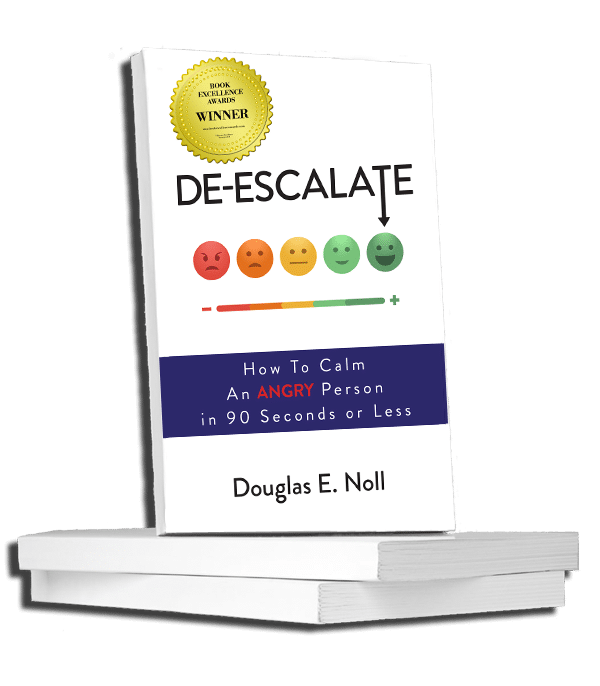
Doug Noll brings more than four decades of frontline experience to this challenge. A seasoned mediator, he has worked in courtrooms, executive suites, and even maximum-security prisons, where he trained life-sentenced inmates in techniques that dramatically reduced prison violence. What distinguishes his approach is its precision and immediacy. He teaches a neuroscience-informed skill called the 90-Second Power Move, a targeted form of affect labeling capable of visibly de-escalating heated moments in well under ninety seconds.
Emotional conflicts fracture teams and families. The ongoing tension breeds burnout, damages relationships, and hurts performance. The Noll Method’s 90-Second Power Move™ is a proven, neuroscience-based skill for restoring calm, tested from boardrooms to maximum-security prisons. Master this life-changing technique to transform chaos into collaboration. Book a no-obligation zoom call with Doug Noll today!
The Real Cost of Letting Tension Simmer
Workplace conflict seldom explodes dramatically. More often it simmers quietly: missed deadlines, passive-aggressive exchanges, fragmented collaboration, and creeping disengagement. Surveys consistently show that unresolved issues lead most people to witness declining team morale, while significant numbers report experiencing bullying, stress-related health problems, or outright absence. Friction appears across all levels, though the most intense concentrations frequently occur between different layers of management.
These patterns produce tangible business damage delayed projects, elevated turnover, and widespread disengagement. Yet the picture is not entirely bleak. Professionals who have seen conflict managed well frequently report stronger relationships, clearer mutual understanding, and fresh ideas emerging from the friction. The critical variable is not the presence of disagreement but the quality of response.
Why Conventional Approaches Often Backfire
Most leaders reach for familiar tactics: active listening, restating the speaker’s points, or simply instructing people to calm down. These strategies frequently produce the opposite effect. Urging composure can register as invalidation, keeping emotional intensity high. Paraphrasing content captures the story but misses the underlying feeling driving the reaction.
Noll’s method reverses that pattern. Rather than debating facts or urging restraint, it addresses the emotion head-on. The 90-Second Power Move rests on a core biological insight, first highlighted by neuroscientist Jill Bolte Taylor: the raw physiological intensity of an emotion typically lasts about ninety seconds unless continually reinforced by thought. A calm, accurate statement such as “You’re feeling really angry and dismissed right now” interrupts that reinforcement loop and triggers a rapid neurological shift toward calm.
The Neuroscience Powering Rapid De-escalation
Research using fMRI, particularly work led by Matthew Lieberman at UCLA, shows that naming emotions known as affect labeling reduces activation in the amygdala (the brain’s alarm center) while increasing engagement in prefrontal regions associated with empathy, reasoning, and regulation. This is not generic emotional-intelligence training; it is a direct, measurable interruption of the fight-or-flight cascade. Precise “you” statements focused exclusively on the felt emotion outperform content-based reflections because they speak immediately to the nervous system’s deep need for safety and being seen.
Noll distills this principle into a reliable, repeatable action: set aside the surface content, identify the dominant emotion, and name it directly without softening qualifiers. A tentative “You seem upset” carries less impact than a clear “You’re furious about being overlooked.” When delivered accurately and calmly, the technique frequently produces noticeable de-escalation within ninety seconds, creating space for rational conversation.
What Sets the 90-Second Power Move Apart
Conventional conflict training often emphasizes negotiation, compromise, or formal mediation steps. Noll focuses first on emergency de-escalation the critical pause that prevents escalation from spiraling. His guarantee stems from real-world testing in extreme environments: prison yards where violence could ignite instantly, high-stakes corporate settings, and everyday workplaces where accumulated stress magnifies volatility.
His unique combination includes rigorous neuroscience grounding, unparalleled frontline experience (including successfully training life inmates to halt violent confrontations), and a straightforward promise: those who master these skills can reliably stop arguments and fights from escalating. Many programs offer theoretical frameworks that falter under pressure; Noll’s method delivers observable calm quickly, without requiring agreement or explanation from the other person.
Addressing the Most Common Doubts
Skepticism arises naturally. “Arguments are simply part of working with people they’ll never disappear completely.” Tension is indeed inevitable wherever humans collaborate, yet chronic escalation and destructive patterns are not. “I’m not convinced this will actually work in real time.” Understandable yet the technique builds on replicated neuroimaging findings and thousands of documented applications across contexts. “Facing emotions directly my own or someone else’s feels uncomfortable or risky.” This is often the deepest reservation. Learning affect labeling requires willingness to engage with feelings rather than avoid them, but that same willingness fosters greater resilience, psychological safety, and authentic connection.
Teams and leaders who adopt these skills report more than just quieter meetings. They experience faster collaboration, stronger retention, and greater capacity to innovate even under stress. As organizations increasingly explore AI-supported monitoring and tailored programs to meet hybrid-work realities, the irreplaceable human ability to de-escalate rapidly remains foundational.
Moving Toward Lower-Cost, Higher-Performance Workplaces
Workplace conflict will always exist, but its destructive impact need not. Verified data underscores that poorly handled disputes impose heavy costs, while skillful intervention transforms friction into constructive energy. Doug Noll’s 90-Second Power Move provides a precise, evidence-based tool for exactly those high-heat moments. It is not mystical it is applied neuroscience executed with discipline.
Leaders who invest in this capability do far more than manage conflict; they prevent its most damaging consequences. In today’s environment of distributed teams, elevated stress, and heightened focus on well-being, rapid de-escalation is no longer optional. It is a core competitive advantage. The next tense exchange is already approaching. The real question is whether it will escalate unchecked or be met with calm, precise intervention that changes the trajectory in ninety seconds or less.
Frequently Asked Questions
What are the hidden costs of unresolved workplace conflict?
Unresolved workplace conflict quietly drains productivity, drives turnover, and undermines team performance across organizations. Workers commonly lose hours each week to interpersonal friction, and a significant percentage leave their jobs entirely because of it. Beyond individual relationships, the ripple effects include delayed projects, widespread disengagement, and stress-related health issues among employees.
What is the 90-Second Power Move, and how does it de-escalate conflict so quickly?
The 90-Second Power Move is a neuroscience-backed de-escalation technique developed by mediator Doug Noll, based on a process called affect labeling directly naming the emotion someone is experiencing. Neuroscientist Jill Bolte Taylor’s research shows that the raw physiological intensity of an emotion lasts roughly ninety seconds unless reinforced by continued thought, and accurately naming that emotion interrupts the cycle. UCLA research confirms that affect labeling reduces amygdala (fight-or-flight) activity while engaging the brain’s reasoning and empathy centers, producing visible calm in under ninety seconds.
Why do common conflict resolution strategies like active listening or telling someone to “calm down” often fail?
Traditional approaches tend to address the content of a dispute rather than the underlying emotion driving it paraphrasing what someone said captures their story but misses the feeling fueling their reaction. Urging someone to calm down can feel dismissive, which actually keeps emotional intensity elevated. Doug Noll’s method bypasses this by targeting the emotion directly with precise “you” statements, speaking to the nervous system’s need to feel seen and safe before any rational conversation can take place.
Disclaimer: The above helpful resources content contains personal opinions and experiences. The information provided is for general knowledge and does not constitute professional advice.
You may also be interested in: Conflict to Collaboration Insights – Douglas E. Noll
Emotional conflicts fracture teams and families. The ongoing tension breeds burnout, damages relationships, and hurts performance. The Noll Method’s 90-Second Power Move™ is a proven, neuroscience-based skill for restoring calm, tested from boardrooms to maximum-security prisons. Master this life-changing technique to transform chaos into collaboration. Book a no-obligation zoom call with Doug Noll today!
Powered by flareAI.co