In an era when mental health crises appear more frequent and complex, frontline providers are sharpening their most essential tool: the way they communicate. Far beyond standard protocols, today’s approaches draw on neuroscience, lived experience, and lessons from real-world encounters to turn potentially volatile moments into opportunities for connection and de-escalation. This quiet but profound shift in crisis communication is helping professionals prevent escalation, preserve dignity, and guide people toward safety and recovery.
Emotional conflicts fracture teams and families. The ongoing tension breeds burnout, damages relationships, and hurts performance. The Noll Method’s 90-Second Power Move™ is a proven, neuroscience-based skill for restoring calm, tested from boardrooms to maximum-security prisons. Master this life-changing technique to transform chaos into collaboration. Book a no-obligation zoom call with Doug Noll today!
The Changing Face of Mental Health Crises
Mental health emergencies rarely follow a script. They unfold in crowded emergency departments, quiet living rooms, police cruisers, school hallways, and 24-hour crisis lines. For decades, responders relied heavily on containment and sedation when words failed. Today the field is moving decisively toward communication-first strategies that prioritize understanding over control.
Well-executed verbal de-escalation frequently lowers agitation more rapidly than physical or chemical restraint, improves cooperation with care plans, and leaves both the person in distress and the provider with greater dignity intact. When someone in acute crisis feels genuinely heard, the physiological alarm state often begins to subside within minutes, creating a narrow window for collaborative problem-solving.
Global events of the past several years have accelerated this evolution. Widespread trauma, social isolation, economic strain, and disrupted support networks have left many people more vulnerable to acute breakdowns. Providers now recognize that effective crisis intervention must address not only immediate safety but also the underlying emotional experience driving the behavior.
Core Elements of Modern Crisis Communication
Refined crisis communication rests on several interlocking skills that can be taught, practiced, and reliably deployed even under pressure.
- Active, non-judgmental listening hearing both the words and the emotion behind them, then reflecting that emotion back so the person knows they have been understood.
- Calm, low, steady tone matched with open body language that signals safety rather than threat.
- Empathy statements delivered early simple acknowledgments such as “This must feel terrifying right now” or “I can see how trapped you feel” that reduce defensiveness.
- Clear, concrete options presented without ultimatums, giving the person in crisis a measure of agency when everything else feels out of control.
- Respectful boundary-setting that protects everyone’s safety while preserving as much autonomy as the situation allows.
These techniques are embedded in structured models such as the six-step crisis intervention framework, which moves methodically from defining the problem through collaborative resolution and follow-up planning. When applied skillfully, the entire sequence can stabilize a volatile situation in a remarkably short time.
Why Empathy Is a Clinical Intervention
Empathy is frequently misunderstood as mere kindness. In crisis work it functions as a powerful neurobiological intervention. Accurate emotional labeling and validation activate the parasympathetic nervous system, helping to down-regulate the fight-flight-freeze response far more effectively than reasoning or reassurance alone. Providers who master this skill report dramatically fewer escalations to physical restraint and noticeably stronger therapeutic alliances even after the acute moment has passed.
Training Investments That Produce Measurable Change
Organizations that prioritize ongoing, scenario-based training see the clearest gains in both staff confidence and patient outcomes. Just as businesses increasingly view leadership development as a strategic necessity, mental health systems are recognizing that communication competence directly influences clinical results, workplace safety, and staff retention. The global corporate leadership training sector, already substantial, continues to expand as companies understand that well-prepared leaders drive engagement, productivity, and long-term financial health. Parallel logic applies in behavioral health: skilled crisis communicators create calmer environments, fewer injuries, and stronger recovery trajectories.
Specialized programs now routinely incorporate role-plays drawn from actual high-risk encounters, neuroscience-informed emotional-regulation techniques, and regular refreshers to combat skill decay. Many agencies pair these efforts with structured debriefing protocols so lessons from difficult calls are systematically captured and shared.
Doug Noll’s Contribution to the Field
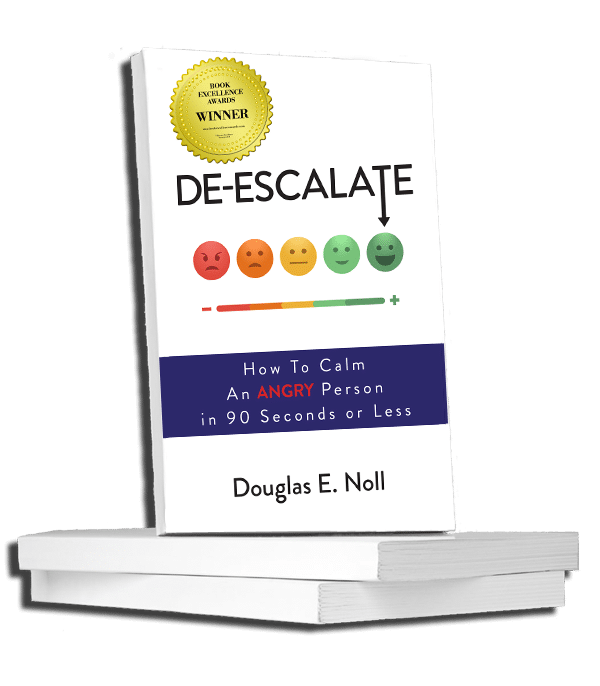
Among the most influential voices shaping contemporary practice is mediator and trainer Douglas E. Noll. Drawing on decades of work in prisons, courtrooms, and healthcare settings, Noll has distilled de-escalation into precise, teachable moves grounded in affective neuroscience.
His signature “90-second” technique hinges on helping a person name their strongest emotion within roughly that timeframe. Once the emotion is accurately labeled, the intensity of the limbic hijack frequently drops sharply, opening space for rational dialogue. Healthcare teams trained in Noll’s methods consistently report that they can calm agitated patients more quickly, experience less secondary trauma themselves, and maintain professional boundaries without becoming emotionally flooded.
Noll also emphasizes self-regulation for the provider. By staying physiologically calm slow breathing, relaxed posture, steady voice the responder models the state they wish to evoke in the other person. This “calm begets calm” principle has become a cornerstone of many forward-leaning crisis programs.
Persistent Challenges and Realistic Solutions
Despite progress, systemic barriers remain formidable. Chronic underfunding leaves many crisis services stretched thin. Rural communities often lack 24/7 mobile teams. Language access and cultural competence gaps persist in diverse urban areas. Burnout continues to erode workforce capacity.
| Obstacle | Emerging Response |
|---|---|
| Workforce burnout | Regular psychological support, manageable caseloads, structured peer debriefing |
| Geographic deserts | Telehealth crisis assessment, regional hub-and-spoke models |
| Cultural and linguistic barriers | Investment in interpreter services, community co-design of protocols |
| Over-reliance on law enforcement | Expanded 988 implementation, co-response programs pairing clinicians with police |
Where these solutions take root, diversion rates climb, arrest rates for mental-health-related calls fall, and individuals receive care in the least restrictive setting possible.
Success in the Field
Real-world programs demonstrate what is achievable. Eugene, Oregon’s CAHOOTS team continues to handle a substantial portion of 911 behavioral-health calls without police involvement, dramatically reducing the use of force. Mobile crisis units in numerous cities now arrive on scene with the clinical authority and time needed to resolve situations in place rather than defaulting to emergency-room transport.
Adoption of the nationwide 988 lifeline has already redirected tens of thousands of calls away from emergency services toward mental-health specialists, with built-in follow-up mechanisms that help prevent repeat crises. Teams incorporating Noll’s listening techniques describe markedly calmer emergency-department environments and noticeably higher patient satisfaction scores even after involuntary holds.
Skilled communication does not erase suffering, but it frequently transforms the experience of being in crisis from one of terror and isolation into one of being seen, respected, and safely guided toward help.
Horizon Lines
Looking forward, several trends appear poised to reshape practice further. Artificial-intelligence-assisted triage may soon help call-center staff prioritize the most urgent contacts. Virtual reality training environments will allow providers to rehearse rare but high-risk scenarios without endangering anyone. Greater emphasis on upstream prevention school-based emotional-literacy programs, community resilience initiatives, routine screening in primary care holds the promise of reducing the sheer volume of acute crises.
None of these advances will matter, however, unless frontline workers receive sustained support to master and maintain sophisticated communication skills. The organizations that make that investment will almost certainly see safer workplaces, better clinical outcomes, and a workforce more likely to stay in the field long-term.
Closing Reflection
The refinement of crisis communication is not an optional upgrade; it is now a core clinical competency. When providers listen accurately, respond with authentic empathy, offer realistic choices, and regulate their own nervous systems, they do far more than manage behavior they help restore a person’s sense of agency in the midst of overwhelming fear. In a field defined by urgency, the willingness to slow down long enough to truly hear another human being remains one of the most potent interventions available. That simple act, repeated thoughtfully across thousands of encounters every day, is quietly rewriting what recovery can look like after the worst moments have passed.
Frequently Asked Questions
What is verbal de-escalation in mental health crisis response, and why is it replacing physical restraint?
Verbal de-escalation is a communication-first approach that uses active listening, empathy statements, calm body language, and collaborative problem-solving to stabilize someone experiencing a mental health crisis. Research and real-world practice show it can lower agitation more quickly than physical or chemical restraint, while preserving the dignity of both the person in crisis and the provider. When someone in acute distress feels genuinely heard, the physiological stress response often begins to subside within minutes opening a window for cooperative care. As a result, mental health providers are now trained to reach for words before resorting to containment.
What are the core techniques mental health professionals use for effective crisis communication?
Modern crisis communication training focuses on several interlocking skills: non-judgmental active listening, a calm and steady tone paired with open body language, early empathy statements (such as acknowledging how trapped or terrified someone feels), and offering clear choices without ultimatums to restore a sense of agency. Providers are also trained in self-regulation using slow breathing and a relaxed posture to model calm, since research supports the “calm begets calm” principle. These techniques are embedded in structured frameworks like the six-step crisis intervention model, which guides responders from defining the problem all the way through follow-up planning.
How is the 988 Suicide and Crisis Lifeline changing mental health emergency response?
The 988 Suicide and Crisis Lifeline has redirected tens of thousands of calls away from emergency services and toward mental health specialists, with built-in follow-up mechanisms designed to help prevent repeat crises. This is part of a broader shift toward diverting behavioral health calls from law enforcement and emergency departments to trained clinicians. Programs like Eugene, Oregon’s CAHOOTS team which handles a significant share of 911 behavioral health calls without police involvement demonstrate that communication-led, clinically guided responses can dramatically reduce the use of force and connect people to care in the least restrictive setting possible.
Disclaimer: The above helpful resources content contains personal opinions and experiences. The information provided is for general knowledge and does not constitute professional advice.
You may also be interested in: How Unique Training Helps Leaders Master Emotional Challenges
Emotional conflicts fracture teams and families. The ongoing tension breeds burnout, damages relationships, and hurts performance. The Noll Method’s 90-Second Power Move™ is a proven, neuroscience-based skill for restoring calm, tested from boardrooms to maximum-security prisons. Master this life-changing technique to transform chaos into collaboration. Book a no-obligation zoom call with Doug Noll today!
Powered by flareAI.co