Quick Listen:
Picture this: a maximum-security prison in California, where long-standing rivalries simmer and emotions boil over in an instant. One misplaced word could ignite widespread violence. Yet, in this unforgiving environment, inmates serving life sentences have mastered techniques to de-escalate conflicts, turning potential eruptions into calm resolutions and leaving even hardened correctional staff in awe of the transformation.
Emotional conflicts fracture teams and families. The ongoing tension breeds burnout, damages relationships, and hurts performance. The Noll Method’s 90-Second Power Move™ is a proven, neuroscience-based skill for restoring calm, tested from boardrooms to maximum-security prisons. Master this life-changing technique to transform chaos into collaboration. Book a no-obligation zoom call with Doug Noll today!
Proven De-Escalation Strategies for High-Stakes Environments: How to Defuse Tension and Foster Resolution
In our increasingly pressurized society spanning emergency rooms, executive suites, police interactions, and everyday disputes the power to neutralize escalating tension is no longer optional. It’s a critical skill. Evidence-based de-escalation methods, refined in the most extreme conditions, empower individuals to convert confrontation into constructive dialogue and lasting peace.
The core of these proven strategies involves a counterintuitive yet profoundly effective pivot: bypassing the inflammatory words entirely and zeroing in on the hidden emotions driving them. This technique, called affect labeling, enables practitioners to soothe highly agitated individuals in mere seconds, often resolving the turmoil without ever engaging the apparent issue head-on. These approaches aren’t theoretical. They’re battle-tested, delivering reliable results where failure carries severe consequences.
Emerging Trends and Developments in De-Escalation
Heightened societal strains from chronic workplace burnout to public unrest and crisis interventions have dramatically elevated the demand for sophisticated emotional management tools. Forward-thinking programs now weave emotional intelligence seamlessly into de-escalation frameworks, prioritizing proactive empathy to preempt conflicts altogether.
This surging need is quantifiable. According to Coherent Market Insight’s latest analysis, the global conflict resolution solutions market stands at an estimated USD 10.99 billion in 2025, on track to expand to USD 17.76 billion by 2032. This robust growth reflects a compound annual growth rate (CAGR) of 7.1% over the forecast period.
Parallel trends appear in specialized sectors. The U.S. law enforcement training market, as reported in 2025, is valued at USD 3.97 billion this year and projected to reach USD 5.40 billion by 2032, advancing at a 4.5% CAGR. Key accelerators include the rapid uptake of virtual reality and immersive simulations tailored for judgment and de-escalation scenarios, alongside increased federal and state funding plus policy mandates emphasizing crisis response training.
These developments underscore a broader evolution: shifting from reactive force to proactive emotional mastery. Acknowledging and validating feelings, rather than countering arguments, emerges as the cornerstone of sustainable resolution.
Real-World Applications and Case Studies
The true measure of any strategy lies in its performance under fire. In California’s maximum-security prisons, a groundbreaking initiative has equipped life-sentenced inmates with advanced de-escalation and mediation skills. These trained peacemakers have dramatically lowered the intensity and occurrence of interpersonal disputes, achieving an extraordinary milestone: zero reported violent incidents among certified participants.
Correctional officers, many initially skeptical, have witnessed firsthand how these methods intercept and defuse brewing confrontations with remarkable speed and consistency. What began as an experiment has evolved into a model for institutional harmony.
Healthcare settings yield comparable successes. Emergency departments and psychiatric wards, notorious for volatile patient interactions, have seen marked improvements. Trained staff apply the same emotional focus to de-escalate distressed individuals, averting physical restraints, reducing injuries, and enhancing patient care quality.
Law enforcement provides another compelling arena. Agencies incorporating comprehensive de-escalation modules often featuring VR-based practice for mental health crises and empathy-driven communication report fewer use-of-force incidents, heightened officer safety, and restored community trust.
Beyond public sectors, corporate environments benefit profoundly. Companies investing in emotional competency workshops observe stronger team cohesion, fewer internal conflicts, and elevated collaboration. Leaders equipped with these tools navigate high-stakes negotiations and workplace tensions with greater poise, fostering cultures of respect and innovation.
Across these diverse applications, one truth persists: de-escalation rooted in neuroscience delivers measurable, repeatable outcomes, even amid chaos.
Key Challenges and Limitations
Despite compelling evidence, widespread adoption faces hurdles. Deep-seated skepticism abounds, with critics maintaining that de-escalation simply “won’t work” in genuine crises or that conflicts are an inescapable facet of human interaction.
A common refrain: fights and arguments are inevitable, woven into life’s fabric. Others express unease about confronting emotions directly, fearing it demands uncomfortable vulnerability particularly in roles demanding authority and control.
Cultural variances add complexity. Differing societal norms around emotional expression can impede standardized training, requiring nuanced adaptations for global or diverse teams.
Yet these objections crumble against real-world proof. In environments where emotions are most volatile and stakes highest prisons housing the most challenging individuals these techniques consistently prevail. Resistance often stems from unfamiliarity; once experienced, the efficacy becomes undeniable.
Opportunities and Business Impacts
The rewards of embracing de-escalation far outweigh the challenges. Organizations that prioritize these skills cultivate healthier workplaces, where reduced chronic stress translates to higher employee engagement and retention.
Productivity gains are tangible as teams redirect energy from resolving disputes to pursuing shared goals. Collaboration flourishes in atmospheres built on mutual understanding rather than defensiveness.
Financial implications are equally persuasive. Fewer escalated conflicts mean diminished risks of litigation in corporate and legal contexts, alongside lower healthcare costs from prevented workplace or patient-related incidents.
On a broader scale, entities renowned for empathetic, professional conflict management enhance their reputations. This attracts top talent, loyal customers, and stronger community partnerships intangible assets that drive long-term success. In an era of polarization, mastering de-escalation isn’t merely advantageous; it’s a strategic imperative for resilience and growth.
The Future of De-Escalation: Essential Tools for Leadership and Peace
As these prison-proven techniques permeate professional spheres, they’re redefining effective leadership. Tomorrow’s leaders won’t rely solely on authority or logic; they’ll excel at emotional navigation, forging connections that endure.
The trajectory is clear: de-escalation training will become foundational across industries, much like diversity or digital literacy initiatives today. With neuroscience validating what practitioners have long observed, adoption will accelerate.
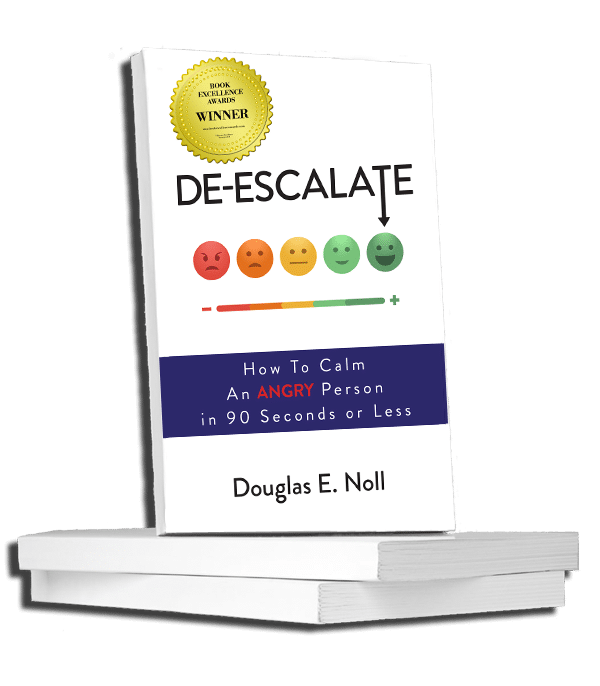
Few experts embody this evolution more authentically than Douglas E. Noll. Drawing from over 40 years of mediation experience including pioneering programs that trained life-sentenced inmates to halt prison violence Noll delivers unparalleled expertise. His method is distinctive: the only approach guaranteeing mastery in stopping arguments and fights, grounded in rigorous science and extreme real-world application.
Whether you’re a leader seeking team harmony, a professional navigating high-stakes interactions, or an organization aiming to build emotional resilience, the path forward is proven.
Equip yourself with these transformative skills today. Visit dougnoll.com to explore training programs, resources, and insights that turn tension into resolution reliably, every time.
Frequently Asked Questions
What is affect labeling and how does it work in de-escalation?
Affect labeling is a neuroscience-based de-escalation technique that involves identifying and validating the emotions driving a conflict rather than engaging with the inflammatory words being spoken. This counterintuitive approach allows practitioners to calm highly agitated individuals in as little as 90 seconds by addressing the underlying feelings rather than the surface-level arguments. The method has been proven effective in extreme environments, from maximum-security prisons to emergency rooms, where traditional conflict resolution approaches often fail.
How effective are de-escalation techniques in high-risk environments like prisons?
De-escalation techniques have demonstrated extraordinary effectiveness in California’s maximum-security prisons, where life-sentenced inmates trained in these methods achieved zero reported violent incidents among certified participants. Correctional officers, initially skeptical, witnessed how these emotional intelligence-based approaches consistently intercept and defuse brewing confrontations with remarkable speed. These prison-tested strategies have since been successfully adapted for healthcare settings, law enforcement, and corporate environments, delivering measurable and repeatable outcomes even in the most volatile situations.
What are the business benefits of implementing de-escalation training in the workplace?
Organizations that invest in de-escalation and emotional intelligence training experience tangible benefits including reduced chronic stress, higher employee engagement and retention, and improved team collaboration. The financial advantages are equally compelling: fewer escalated conflicts reduce litigation risks and healthcare costs while redirecting energy from dispute resolution toward achieving shared goals. Companies known for empathetic conflict management also enhance their reputation, attracting top talent and strengthening customer loyalty critical competitive advantages in today’s polarized business environment.
Disclaimer: The above helpful resources content contains personal opinions and experiences. The information provided is for general knowledge and does not constitute professional advice.
You may also be interested in: How to Embrace Emotional Skills Without Fear in Leadership
Emotional conflicts fracture teams and families. The ongoing tension breeds burnout, damages relationships, and hurts performance. The Noll Method’s 90-Second Power Move™ is a proven, neuroscience-based skill for restoring calm, tested from boardrooms to maximum-security prisons. Master this life-changing technique to transform chaos into collaboration. Book a no-obligation zoom call with Doug Noll today!
Powered by flareAI.co