Quick Listen:
Picture a tense executive meeting where voices rise and frustration boils over until one person calmly states, “It seems like you’re feeling deeply frustrated by this setback.” Almost instantly, the atmosphere shifts. Defenses drop. Dialogue resumes. This isn’t mere coincidence or exceptional interpersonal luck. It’s the deliberate application of affect labeling, a neuroscience-backed technique that’s emerging as one of the most effective tools for rapid conflict resolution in high-stakes environments.
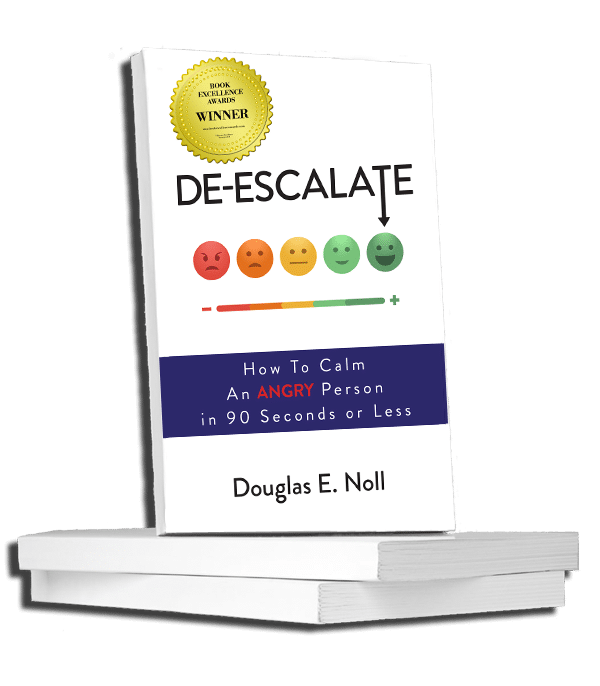
Emotional conflicts fracture teams and families. The ongoing tension breeds burnout, damages relationships, and hurts performance. The Noll Method’s 90-Second Power Move™ is a proven, neuroscience-based skill for restoring calm, tested from boardrooms to maximum-security prisons. Master this life-changing technique to transform chaos into collaboration. Book a no-obligation zoom call with Doug Noll today!
Affect Labeling: The Powerful Technique for Rapid Conflict Resolution in High-Stress Situations
Affect labeling, at its essence, means accurately naming the emotions someone is experiencing during a charged interaction. Phrases like “You’re feeling angry about this” or “This situation is leaving you overwhelmed” reflect the emotion back without arguing, advising, or minimizing it. This approach forms the foundation of sophisticated de-escalation strategies and is proving essential across North American workplaces, households, and even high-security institutions.
Doug Noll, an award-winning mediator, bestselling author, and pioneer of the Noll Method™, has refined this into his signature “90-Second Power Move.” With more than 40 years of experience including successfully training individuals serving life sentences in maximum-security prisons to halt violence Noll has demonstrated that precise, empathetic emotional labeling can transform escalating confrontations into calm remarkably quickly.
The Science Behind Affect Labeling
The effectiveness of affect labeling stems from its direct impact on brain function. Pioneering neuroimaging research conducted at UCLA, led by psychologist Matthew D. Lieberman, has revealed that simply putting feelings into words significantly reduces activity in the amygdala the brain’s primary center for processing fear, anger, and stress responses.
In one landmark study published in Psychological Science, participants who labeled the emotions shown in negative images exhibited markedly lower amygdala activation compared to those who merely observed or categorized the images in non-emotional ways. Simultaneously, activity increased in the right ventrolateral prefrontal cortex, a region associated with emotional regulation and impulse control. Functional MRI data showed that this prefrontal engagement effectively dampens amygdala reactivity, creating a neural pathway that interrupts intense emotional surges.
These mechanisms explain the technique’s speed: when applied correctly, affect labeling can de-escalate heightened emotions in as little as 90 seconds, preventing arguments or physical confrontations from intensifying further.
Emerging Trends in Conflict Resolution
Across North America, emotional intelligence is increasingly recognized as indispensable for effective leadership and organizational health. Diverse teams, hybrid work models, and heightened workplace pressures have amplified disputes, driving demand for advanced resolution strategies.
According to a Coherent Market Insights report, the North America workplace conflict management solution market is valued at USD 3.56 billion in 2025 and is projected to grow to USD 7.40 billion by 2032, achieving a compound annual growth rate (CAGR) of 11%. This expansion reflects organization’s urgent need for tools such as mediation platforms, grievance systems, and AI-enhanced analytics to address tensions proactively before they erode productivity or lead to litigation.
The broader corporate training landscape reinforces this priority. A report from Allied Market Research indicates that the global corporate training market, heavily driven by North American demand, stood at $361.5 billion in 2023 and is forecasted to reach $805.6 billion by 2035, expanding at a 7% CAGR from 2024 to 2035. Remote work’s persistence has accelerated adoption of virtual and face-to-face training focused on soft skills, including communication, leadership development, and conflict resolution.
Meanwhile, the global conflict resolution solutions market encompassing mediation, arbitration, negotiation, and coaching is expected to rise from US$ 10.99 billion in 2025 to US$ 17.76 billion by 2032, with a 7.1% CAGR. Rising workplace disputes and preference for alternative dispute resolution (ADR) fuel this growth, aligning perfectly with affect labeling’s non-adversarial, empathy-centered approach.
Real-World Applications of Affect Labeling
In professional settings, affect labeling shines during negotiations or team conflicts. When one party feels dismissed, a skilled leader or mediator might say, “It sounds like you’re feeling undervalued in this process.” This validation often neutralizes defensiveness, paving the way for constructive solutions.
Organizations in sectors like healthcare, technology, and education increasingly incorporate these techniques into executive training programs. Outcomes include reduced escalations, enhanced collaboration, and improved employee retention.
Beyond the office, the method transforms personal relationships. In family therapy or parenting, labeling a child’s or partner’s emotions “You’re scared about this change” can swiftly de-escalate outbursts and foster deeper connection. Marriage counselors and family mediators report consistent success with this tool.
Noll’s most compelling proof comes from extreme contexts: maximum-security prisons, where he has taught affect labeling to inmates with histories of violence. Participants learn to interrupt cycles of aggression, proving the technique’s robustness. If it succeeds in such environments, its potential in corporate boardrooms or domestic disputes is profound.
Challenges and Limitations of Affect Labeling
Despite robust evidence, resistance persists. Many express doubt: “I don’t believe it will actually work in a real heated moment.” Others accept conflict fatalistically “Arguments are just part of life; they’ll never stop.”
A deeper hurdle is emotional vulnerability. Confronting and naming feelings can feel exposing, leading some to avoid the practice altogether. Moreover, poor execution such as inaccurate labeling or sarcastic tone can exacerbate tension rather than relieve it. Success demands empathy, precision, and practice. Missteps are possible, but when mastered, affect labeling reliably calms emotional storms.
Opportunities and Business Impact
As conflict resolution advances, affect labeling distinguishes itself through speed and simplicity. Integrated into training initiatives, it promises lower workplace stress, higher employee engagement, and more cohesive cultures.
Professionals equipped with this skill via executive coaching, keynote sessions, or mediation services hold a decisive advantage in fostering productive environments. Noll stands alone in teaching his proprietary version, backed by unique prison-validated results and his personal guarantee: master it, and you’ll consistently stop fights and arguments.
For organizations, investing in such capabilities aligns with market trends emphasizing proactive, humane dispute management over reactive measures.
The Future of Conflict Resolution in North America
Forward-looking experts predict that neuroscience-informed techniques like affect labeling will become standard in leadership development and organizational strategy. As hybrid work solidifies and demographic diversity grows, tools enabling rapid, empathetic de-escalation will be prioritized to prevent burnout and costly conflicts.
Innovations integrating AI with human-centered methods may further amplify impact, but the core insight remains: naming emotions accurately disrupts their destructive power.
Mastering the 90-Second Shift
In an era defined by rapid triggers and lingering tensions, affect labeling provides a reliable pathway to calm. Supported by rigorous brain science and proven across continents from high-rise offices to family homes to correctional facilities it converts potential ruptures into moments of genuine understanding.
Next time conflict flares, pause and name the underlying emotion with care. The change can be immediate. To fully develop this capability for professional or personal use, consider the comprehensive programs offered at dougnoll.com, where the complete Noll Method is taught. In less than two minutes, profound shifts become possible.
Frequently Asked Questions
What is affect labeling and how does it help with conflict resolution?
Affect labeling is a neuroscience-backed technique that involves accurately naming the emotions someone is experiencing during a charged interaction, such as saying “You’re feeling frustrated by this setback.” Research from UCLA shows that simply putting feelings into words reduces activity in the amygdala the brain’s fear and stress center while activating regions associated with emotional regulation. This process can de-escalate heightened emotions in as little as 90 seconds, preventing arguments from intensifying and transforming confrontations into constructive dialogue.
Does affect labeling really work in high-stress or violent situations?
Yes, affect labeling has been proven effective even in extreme environments like maximum-security prisons. Douglas E. Noll successfully trained life-sentenced inmates in California prisons to use this technique, achieving zero reported violent incidents among certified participants and dramatically reducing interpersonal disputes. If affect labeling succeeds in such volatile settings where emotions run highest, it demonstrates profound potential for corporate boardrooms, emergency rooms, law enforcement interactions, and everyday conflicts where the stakes are comparatively lower.
How can I use affect labeling in my workplace or personal relationships?
To apply affect labeling effectively, focus on accurately naming the emotion you observe rather than arguing or offering advice for example, “It sounds like you’re feeling undervalued in this process” or “You seem overwhelmed by this situation.” The key is empathy, precision, and a calm tone; when done correctly, this validation often neutralizes defensiveness and opens the door to constructive solutions. Organizations across healthcare, technology, and education are incorporating affect labeling into leadership training, while family therapists use it to de-escalate conflicts between partners and parents with children, proving its versatility across professional and personal contexts.
Disclaimer: The above helpful resources content contains personal opinions and experiences. The information provided is for general knowledge and does not constitute professional advice.
You may also be interested in: The Role of Experience in Teaching Conflict De-escalation
Emotional conflicts fracture teams and families. The ongoing tension breeds burnout, damages relationships, and hurts performance. The Noll Method’s 90-Second Power Move™ is a proven, neuroscience-based skill for restoring calm, tested from boardrooms to maximum-security prisons. Master this life-changing technique to transform chaos into collaboration. Book a no-obligation zoom call with Doug Noll today!
Powered by flareAI.co