The A.R.A. Framework: Acknowledge, Reflect, Ask
A thirty-second protocol for calming reactivity and restoring deliberative thinking in high-stakes conversations
The A.R.A. framework (Acknowledge, Reflect, Ask) is a three-step conversational protocol developed by Douglas E. Noll for calming emotional reactivity and restoring deliberative thinking in high-stakes leadership conversations. The leader first acknowledges the dominant emotion, then reflects the meaning or stakes behind it, then asks a forward-looking question that returns agency to the other person. It takes about thirty seconds and is the core practice taught in Noll's book Empathy Leadership.
Key takeaways
- Acknowledge: name the emotion you perceive. "You feel blindsided and angry."
- Reflect: name what is at stake for them. "You're worried this deadline will damage your credibility with the client."
- Ask: restore agency with a forward-looking question. "What would help right now?"
- The order matters: calm first, then reflect, then ask, because A.R.A. is a sequence rather than a sentiment.
- A.R.A. is observable and measurable, which makes it trainable at scale and trackable through the LEMS.
What is the A.R.A. framework?
In a heated moment, leaders need faster access to emotional regulation for themselves and the room far more than they need persuasive content. A.R.A. provides that access as a bridge between the neuroscience of affect labeling and the daily reality of one-on-ones, team meetings, escalation calls, performance reviews, board updates, and hallway conversations that suddenly go sideways.
A.R.A. is a sequence that follows the brain's own order of operations: settle the threat response, show you understand what matters to the person, and then invite the deliberative brain back into the conversation.
The three steps
Step 1: Acknowledge the dominant emotion
Name the emotion you perceive with a direct, declarative you-statement such as "You feel blindsided and angry," avoiding hedges like "I sense you might be upset," questions like "Are you angry?" and self-referential phrases like "I hear you saying you're frustrated."
Why it works: Putting feelings into words increases activity in the right ventrolateral prefrontal cortex and reduces activity in the amygdala, the brain's threat detector (Lieberman et al., 2007). Leaders often fear that naming an emotion will make it worse, while the evidence shows an accurate label lowers arousal enough to make the next step possible.
Step 2: Reflect the meaning or consequence driving the emotion
Every emotion carries a prediction: fear expects danger, shame expects rejection, and pride expects recognition. Reflection names that stake, as in "You're worried this slip will cost you credibility with the client" or "You feel your warnings about the design were ignored, and now it's going to land on you."
Why it works: Reflection signals that you understand why the feeling matters to the person, a skill I call predictive empathy because it connects someone's emotional state to the consequences they anticipate. It draws on the brain's mentalizing network, including the medial prefrontal cortex and temporoparietal junction, and research on perceived listening has found that being understood from one's own frame of reference engages reward-related circuitry. Being accurately understood, which I call felt accuracy, is a primary driver of trust and psychological safety, because people regulate the emotions they can name and drown in the ones they cannot.
Step 3: Ask a forward-looking question
Once the person has visibly settled, ask a question that restores choice, such as "What would help right now?", "Where is the real constraint?", or "What can we do in the next twenty-four hours?"
Why it works: A well-timed question shifts the person from threat monitoring to choosing an action, engaging the brain's valuation and control circuits and pulling deliberative thinking back online. You will see the change as posture shifts, tone steadies, and language moves from blame to options.
A.R.A. in action
Raj, a senior project manager at an aerospace firm, walked into his team's war room and found two engineers arguing over test failures, one red-faced and the other silent and seething.
Instead of asking for data, Raj said: "You're furious that your work is being questioned, and you're frustrated because you feel no one is listening to your warnings about the design flaw." Both nodded, still tense.
He continued: "You're both scared this launch could fail and that it'll land on you." Shoulders dropped, and the silence turned into breathing room.
Then he asked: "What would help us move forward from here?" Within minutes the engineers were sketching solutions together on the whiteboard.
Raj acknowledged, reflected, and asked, and the fight dissolved because he restored safety rather than enforcing order.
Why the order matters
Leaders who skip to the question ask a brain under threat to deliberate, and leaders who skip the acknowledgment offer analysis to a nervous system that needs regulation, so the usual result is compliance without commitment.
Why "we tried empathy and it didn't work"
When leaders tell me empathy failed them, closer listening usually reveals they practiced politeness, sympathy, or emotional management. The predictable failure modes are these:
- The cognitive substitution error replaces connection with analysis, as in "I understand why you're angry."
- Self-referential listening such as "I hear you saying you're upset about the budget" centers the listener and, under high emotion, often sounds procedural or patronizing. In one case from the book, a CFO's "I hear you saying" made a program director angrier, while his second attempt, "You feel betrayed and humiliated that this decision blindsided your team," drew an exhale and "Exactly."
- Hedging with phrases like "I get it, but" or "Let's not get emotional" bypasses the emotional brain entirely.
- Premature problem-solving is often an attempt to soothe the leader's own anxiety, and it tells the other person their emotions don't matter.
- Asking instead of naming with "How are you feeling?" forces a dysregulated person to find words they may not have; name the emotion, and if you are wrong, reflect their correction.
Practicing A.R.A. on yourself first
Leaders cannot reliably run A.R.A. on others while they are internally flooded, so the protocol begins with presence. Before a hard conversation, run it silently on yourself: acknowledge your own emotion ("I feel anxious and defensive"), reflect the stake ("I'm worried this will make me look like I lost control of the project"), and ask what you need from the conversation. Your nervous system sets the room's baseline, and both calm and threat are contagious.
A.R.A. with teams and across organizations
A.R.A. scales from a single conversation to a culture. In Empathy Leadership I describe several ways organizations embed it:
- A.R.A. rounds pause the agenda when conflict surfaces so the leader can acknowledge the group's emotions, reflect the stakes for each function, and ask what would help.
- One-minute A.R.A. check-ins open recurring meetings.
- A.R.A. in performance reviews puts acknowledgment before feedback so the feedback can land.
- Coaching and observation pair new managers with coaches who watch real conversations and give feedback on frequency and accuracy.
- Measurement through the Behavioral Practice pillar of the Leadership Empathy Measurement System (LEMS) tracks how often and how accurately leaders use A.R.A.
At mastery, A.R.A. becomes a way of being present that people notice most when it is missing.
A twenty-four-hour A.R.A. experiment
- Pick your next tense conversation, at work or at home.
- Before you respond to content, name one emotion with a you-statement and stop talking.
- When you see the person settle, reflect what is at stake for them.
- Ask what would help.
- Afterward, write down what changed in their body, their voice, and the direction of the conversation.
A.R.A. is one expression of a larger practice I call Nervous System Leadership, built on the skill of listening someone into existence.
Frequently asked questions
What does A.R.A. stand for?
A.R.A. stands for Acknowledge, Reflect, Ask. Acknowledge the dominant emotion, reflect the meaning or stakes behind it, then ask a forward-looking question that gives the person back a sense of agency.
Who developed the A.R.A. framework?
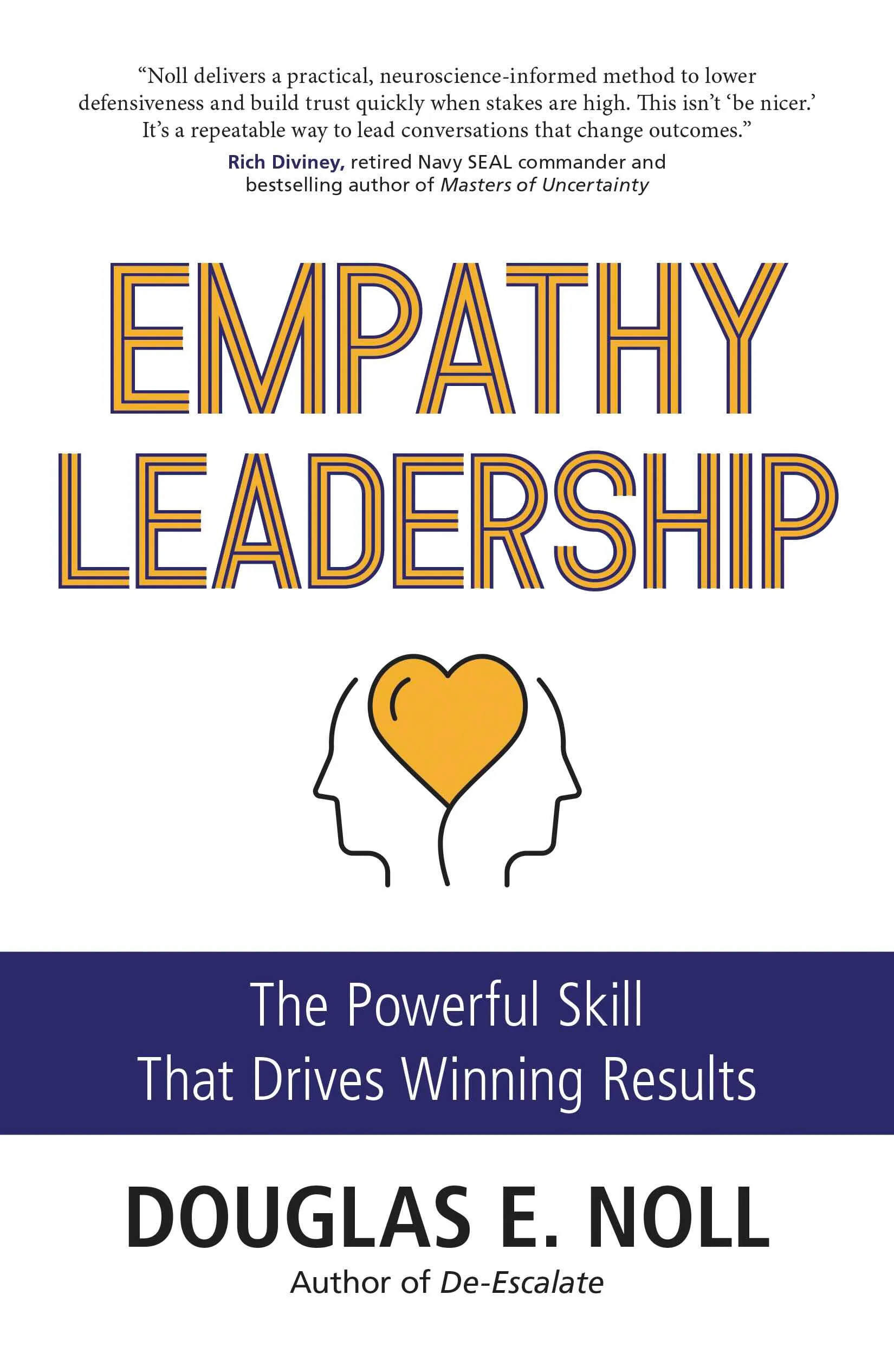
Douglas E. Noll, JD, MA, mediator and author, developed the A.R.A. framework and presents it in his book Empathy Leadership: The Powerful Skill That Drives Winning Results (Beyond Words/Atria, Simon & Schuster, 2026).
Why does the order of A.R.A. matter?
The sequence follows the brain. Acknowledging the emotion reduces threat activity so the person can hear you. Reflecting the stakes creates the experience of being accurately understood, which builds trust. Asking a question only works once the deliberative brain is back online. Skipping to the question asks a brain under threat to deliberate.
How long does A.R.A. take?
A single A.R.A. sequence can be done in about thirty seconds. In heated situations it may take a few rounds of acknowledging and reflecting before the person settles enough for the question.
How is A.R.A. different from active listening?
Active listening typically paraphrases content and often uses self-referential phrases such as "I hear you saying." A.R.A. names the emotion directly with a you-statement, reflects what is at stake, and only then moves to a question. Under high emotion, Noll argues the direct approach de-escalates more reliably.
Can A.R.A. be used with teams?
Yes. Organizations use A.R.A. rounds when conflict surfaces in meetings, one-minute A.R.A. check-ins, A.R.A. at the start of performance reviews, and coaching on real conversations. Its use can be tracked through the Behavioral Practice pillar of the Leadership Empathy Measurement System (LEMS).
Related frameworks
- Affect Labeling and Leadership
- The Leadership Empathy Measurement System (LEMS)
- Nervous System Leadership
- Listen Someone Into Existence
- Empathy Leadership (book)
References
- Lieberman, M. D., Eisenberger, N. I., Crockett, M. J., Tom, S. M., Pfeifer, J. H., & Way, B. M. (2007). Putting feelings into words: Affect labeling disrupts amygdala activity in response to affective stimuli. Psychological Science, 18(5), 421-428. https://doi.org/10.1111/j.1467-9280.2007.01916.x
- Torre, J. B., & Lieberman, M. D. (2018). Putting feelings into words: Affect labeling as implicit emotion regulation. Emotion Review, 10(2), 116-124. https://doi.org/10.1177/1754073917742706
- Yip, J. A., & Schweitzer, M. E. (2019). Losing your temper and your perspective: Anger reduces perspective-taking. Organizational Behavior and Human Decision Processes, 150, 28-45. https://doi.org/10.1016/j.obhdp.2018.07.003
- Noll, D. E. (2026). Empathy Leadership: The Powerful Skill That Drives Winning Results. New York / Portland, OR: Atria Paperback / Beyond Words (Simon & Schuster). https://dougnoll.com/books/empathy-leadership
About the author
Douglas E. Noll, JD, MA is a mediator, peacemaker, and leadership advisor. He practiced as a commercial trial lawyer for twenty-two years before turning full time to mediation in 2000 and has since mediated more than 1,500 disputes. He is a Distinguished Fellow of the International Academy of Mediators, an adjunct professor at Pepperdine University's Straus Institute for Dispute Resolution, and co-founder of Prison of Peace. He is the author of five books, including Empathy Leadership: The Powerful Skill That Drives Winning Results (Simon & Schuster, 2026) and De-Escalate: How to Calm an Angry Person in 90 Seconds or Less (2017), and host of the Listening with Leaders podcast. His TEDx talk is "Listen Someone Into Existence." Contact Doug.