Executive Function: Stop Reactive Management Now
%201.avif)

Reactive managers feel productive.
They answer instantly.
Jump into every issue.
Solve problems in real time.
Stay in constant motion.
The organization praises responsiveness while execution quietly deteriorates.
If a senior leader earning $250,000 spends 40 percent of their week reacting instead of thinking strategically, that equals roughly $100,000 annually in lost executive capacity.
If reactive leadership slows decision quality across a $25 million operation by just 5 percent, the downstream drag exceeds $1.25 million.
This is the Reactivity Tax.
And most organizations reward it accidentally.
The diagnosis
You believe fast reactions equal strong leadership.
You believe availability signals commitment.
You believe staying constantly engaged keeps things under control.
Biologically, reactive management is nervous system instability disguised as productivity.
The amygdala activates whenever uncertainty, urgency, or conflict appears.
Cortisol rises.
The prefrontal cortex, responsible for executive function, strategic planning, impulse control, and prioritization, loses efficiency.
Now leadership becomes short term.
Everything feels urgent.
Nothing receives deep attention.
Reactive managers confuse motion with progress.
The organization absorbs the cost.
Want Doug to walk your leadership team through the Noll Method? Book a no-obligation Zoom call with Doug Noll.
The four ways reactive management destroys performance
1. The interruption addiction loop
Every notification becomes emotionally loaded.
Slack message.
Email.
Escalation.
Calendar request.
The nervous system becomes conditioned for interruption.
Frequent interruption reduces deep cognitive work dramatically.
If a leader loses 15 minutes of focus recovery after every interruption and experiences 20 interruptions daily, that equals 5 hours of lost cognitive capacity per day.
Strategic thinking disappears under fragmentation.
2. The emotional urgency effect
Reactive managers mirror stress into the organization.
Fast tone.
Rapid pacing.
Constant escalation.
The team’s amygdala synchronizes with leadership tension.
Cortisol spreads socially.
Now the entire department operates in survival mode.
Survival mode kills long term thinking.
3. The decision fatigue spiral
Reactive leadership forces constant micro decisions.
The prefrontal cortex depletes under repeated decision switching.
As fatigue increases:
- Patience decreases
- Judgment weakens
- Emotional reactivity rises
- Risk assessment worsens
The organization starts making emotionally driven decisions while believing they are rational.
4. The dependency culture
Reactive leaders solve problems too quickly.
Teams stop thinking independently because leadership always intervenes immediately.
Ownership erodes.
Escalation volume increases.
Now leadership becomes operational bottleneck instead of strategic driver.
The neuroscience of executive function
The prefrontal cortex governs:
- Strategic reasoning
- Prioritization
- Emotional regulation
- Long term planning
- Impulse control
It functions best under regulated emotional conditions.
The amygdala overrides prefrontal control during perceived threat.
Constant urgency keeps cortisol elevated.
Elevated cortisol reduces executive function capacity.
Reactive management is often a neurological state, not a personality style.
The leader’s nervous system becomes addicted to urgency cycles.
That addiction destroys clarity.
The counterintuitive protocol
Stop solving immediately.
Regulate first.
When pressure spikes, do not react instantly.
Pause long enough to identify the emotional state precisely.
“This feels urgent.”
Pause.
“I am frustrated.”
Pause.
“There is pressure here.”
Pause.
Accurate emotional labeling reduces amygdala activation and lowers cortisol.
Now the prefrontal cortex regains influence.
When a team member escalates emotionally, do not mirror urgency.
Say:
“You seem concerned this is falling apart.”
Pause.
Or:
“You are frustrated by the delay.”
Pause.
Short, declarative emotion labels.
No immediate fixing.
No rushed decisions.
Once regulation occurs, ask:
“What actually requires action right now?”
Or:
“What happens if we wait 30 minutes before responding?”
Now leadership shifts from reaction to intentional control.
If restoring executive function recovers just 5 hours weekly for a senior leadership team of 5 executives at $125 per hour, the annual value exceeds $160,000 in direct cognitive capacity alone.
If improved strategic clarity prevents one failed initiative or one major hiring mistake, the return compounds into seven figures.
Reactive management feels powerful.
Regulated leadership scales.
Your organization does not need faster reactions.
It needs nervous systems stable enough to think clearly under pressure.
Emotional Competence Shapes Your Influence as a Leader
This 90-second emotional competence quiz will tell you how your emotions affect the way you are treated at work and how to gain the respect and influence you deserve as a leader.
Take the Free Assessment
Doug’s Books
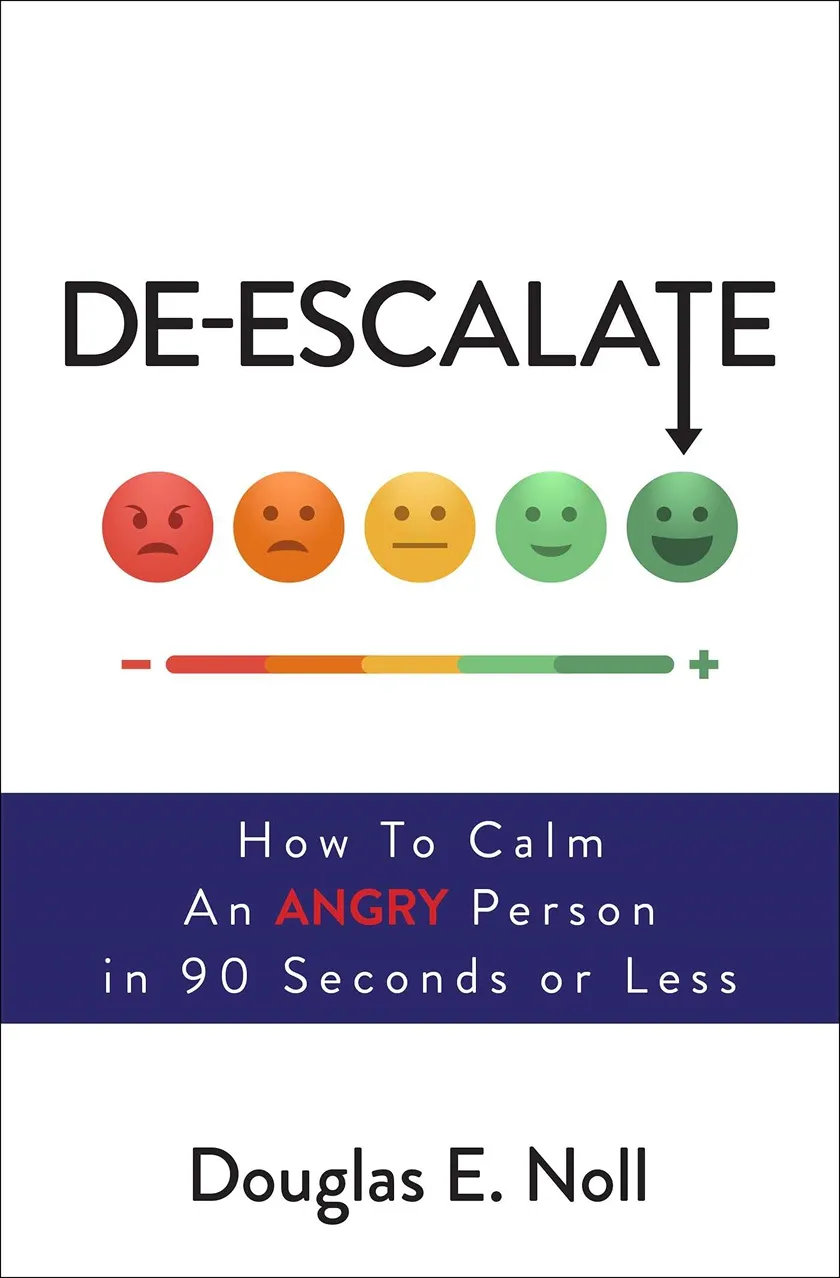
Doug has authored several books on affect labeling and emotional competency, including De-Escalate: How to Calm an Angry Person in 90 Seconds or Less, which won multiple awards and has been adopted by organizations worldwide.


More Blogs
View All

October 23, 2026
6 Powerful Reasons De-Escalation Training for Employees Doesn't Scale (and the Fix)
Read Blog

October 23, 2026
How Executive Dispute Mediation Actually Resolves a Board-Level Rupture
Read Blog

October 22, 2026
4 Critical Failures of Most Corporate Mediation (and the Approach That Works)
Read Blog