How to Be Assertive Without Being Aggressive at Work: 7 Powerful Techniques


The Chief Operating Officer had been passed over for CEO for the second time, and she was trying to work out what the pattern was.
Her reviews had always been strong. Her delivery was consistently above target. Her team retention was excellent. In the private debrief after the second CEO succession, the board chair told her the honest reason. The board was not confident she could push back on the people she needed to push back on. Her assertiveness, in high-stakes moments, was not where it needed to be for the role.
Here are the seven powerful techniques for being assertive without being aggressive at work, each tested in situations where the alternative was being seen as not senior enough.
1. Lead with the decision, then explain the reasoning
Non-assertive leaders explain the reasoning first and then arrive at the decision. "Given the market conditions, the pipeline data, and the resourcing constraints, I think we should probably hold off on the enterprise expansion for one more quarter."
Assertive leaders lead with the decision, then explain the reasoning. "We are holding off on the enterprise expansion for one more quarter. Here is why." Same substance. Different structure. The second version reads as a leader making a decision. The first reads as a leader hoping the room will arrive at the right decision with them.
The structural change takes no additional time and changes how senior you read.
2. State positions as positions, not as questions
Non-assertive leaders often state their positions as questions. "Do you think we should hold off?" "Could we maybe look at a different approach?" The question form invites discussion but costs authority.
Assertive leaders state positions as positions. "I think we should hold off." "I want us to look at a different approach." The position form invites engagement without surrendering authority. The difference is subtle and consequential.
Audit your own language in material conversations for the frequency of question-form positions. If more than 20 percent of your positions are stated as questions, you are reading as less assertive than you need to be.
3. Use specific language for soft challenges
Soft challenges often get softened into unrecognisable form. "I kind of wonder whether we might want to maybe consider another option" is a soft challenge that reads as agreement.
The assertive version is specific and brief. "I disagree with this. Here is my case." Three sentences. The challenge is clear, the argument follows, the room can engage with substance rather than guessing whether a challenge is being offered.
Specificity in challenge language is one of the most reliable markers of senior assertiveness.
4. Hold the pause after you have stated your position
After you have stated a position, hold the silence until the room responds. Non-assertive leaders fill the silence with qualifications and softeners. "I mean, I could be wrong about this." "Obviously you all know more about this than I do." The qualifications undo the position.
Assertive leaders state the position and let the silence sit. The silence feels longer than it is. The room responds in its own time. Your position stands intact.
Practising this specific discipline is uncomfortable at first and transforms how senior you read within weeks.
If a leader is losing one career-defining opportunity every two years to assertiveness patterns that read as not-senior-enough, the compounding cost over a career is substantial. The exact impact for your specific situation is harder to calculate but is almost always in seven figures over a decade.
5. Decline without apologising
Non-assertive leaders apologise for declining things. "I am so sorry, I just do not think I can take that on right now." The apology undermines the decline.
Assertive leaders decline cleanly. "No, that will not fit in my current priorities." No apology. No softening. The decline is a decision, not a request for forgiveness.
Clean declines are a specific marker of senior authority. They also protect your actual priorities, which is the operational reason for the discipline.
6. Give direct feedback without ornament
Non-assertive feedback is ornamented. "You did a really great job on most of this, and there were a few small things I wanted to flag, which are probably not that important, but I thought I should mention them." The ornament undermines the feedback.
Assertive feedback is direct. "The analysis is strong. Three specific things need to change before Friday. Here they are." The feedback is received as feedback rather than as a social navigation exercise.
Direct feedback is more respectful of the recipient than ornamented feedback, which treats them as unable to handle direct communication.
7. Occupy physical space the role requires
Non-assertive leaders occupy less physical space than their role requires. They sit back from the table. They do not take the central seat. They apologise for interrupting. They defer when they should hold the floor.
Assertive leaders occupy the space the role requires. They sit forward. They take the appropriate seat. They interrupt when the discussion needs redirecting. They hold the floor when they are speaking.
The physical dimension of assertiveness is not performance. It is matching the physical presence to the authority of the role. Mismatches read quickly to the people in the room.
Doug Noll teaches Decision-Making Under Stress and Conflict at Pepperdine's Straus Institute. His work with executives on assertiveness is built around the seven techniques above, each developed in situations where the leader needed to shift from capable to senior.
If you are being read as capable but not senior enough, Doug runs a 20-minute diagnostic call to work out the specific patterns that are producing the perception. Book 20 minutes with Doug.
The COO's third succession
She worked on the seven techniques consistently for 18 months. The next CEO succession at her company was a planned transition. She was the chosen successor. The board chair told her, in a different debrief, that the specific change in her assertiveness pattern had been the deciding factor.
For related reads, see asserting yourself in a male-dominated boardroom and how to overcome fear of confrontation in executive meetings.
Being assertive without being aggressive at work is seven specific techniques. The techniques are observable, trainable, and consequential. Leaders who master them are read as more senior than those who do not, regardless of underlying capability.
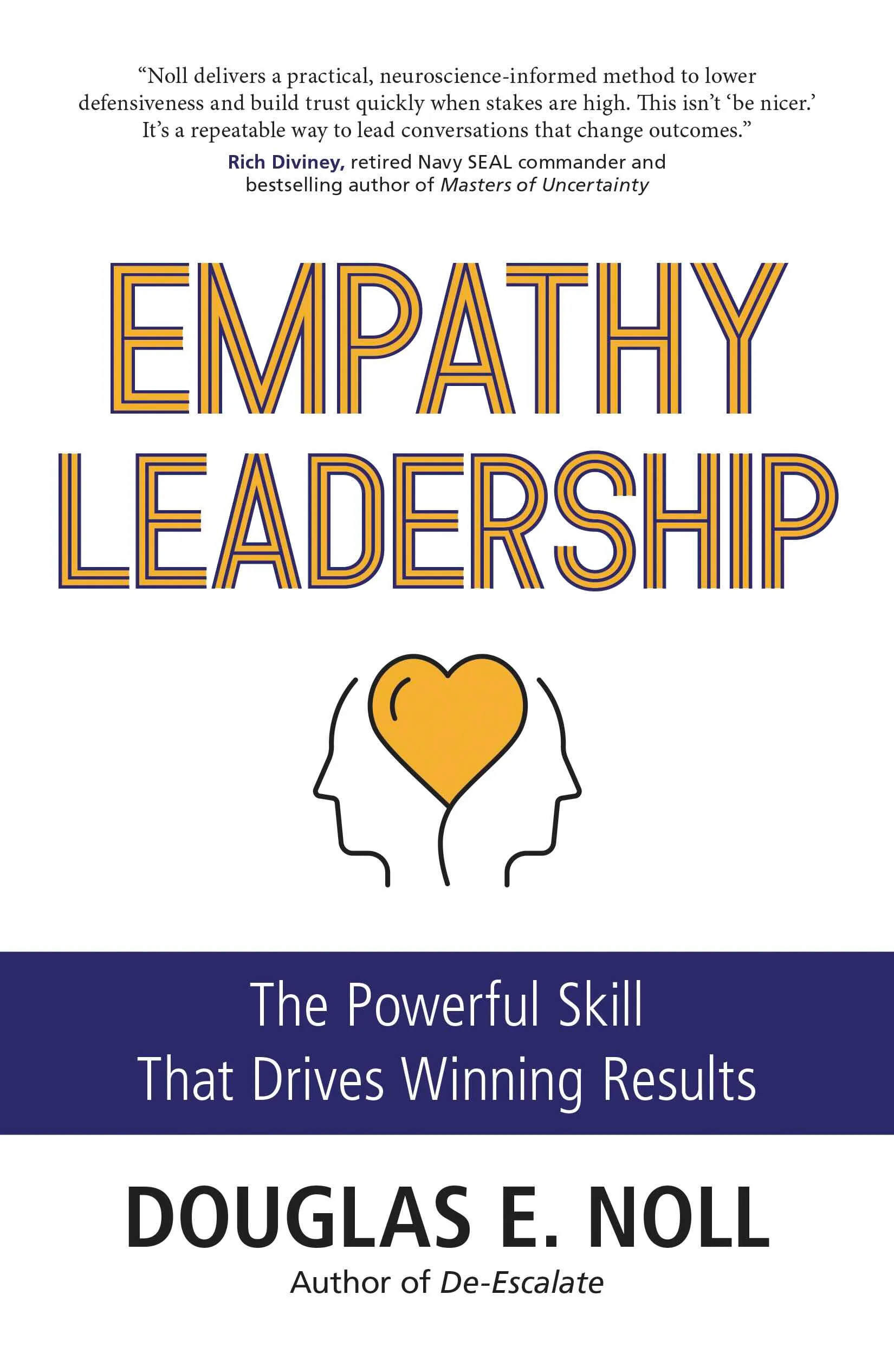
Empathy Leadership: The Powerful Skill That Drives Winning Results is out now. Order on Amazon, or if a 20-minute call would be more useful, Doug's calendar is here.
Emotional Competence Shapes Your Influence as a Leader
This 90-second emotional competence quiz will tell you how your emotions affect the way you are treated at work and how to gain the respect and influence you deserve as a leader.
Take the Free Assessment
Doug’s Books
Doug has authored several books on affect labeling and emotional competency, including De-Escalate: How to Calm an Angry Person in 90 Seconds or Less, which won multiple awards and has been adopted by organizations worldwide.